A proper finishing cut, also called a proper removal cut, is made just outside the branch collar and branch bark ridge. It is not a stub cut, and it is not a flush cut. Those two mistakes look different, but both slow wound closure and raise the chance of decay moving into the parent stem.
At Wise Oak Tree Service, pruning in Waco, Temple, Marlin, and nearby Central Texas follows that standard. Owner Andrew Moody is an ISA Certified Arborist (TX-5039A) and Texas Oak Wilt Qualified (TXOWQ-610). The goal of a good cut is not a perfectly flat trunk. The goal is a wound the tree can compartmentalize.
What is a proper finishing cut?
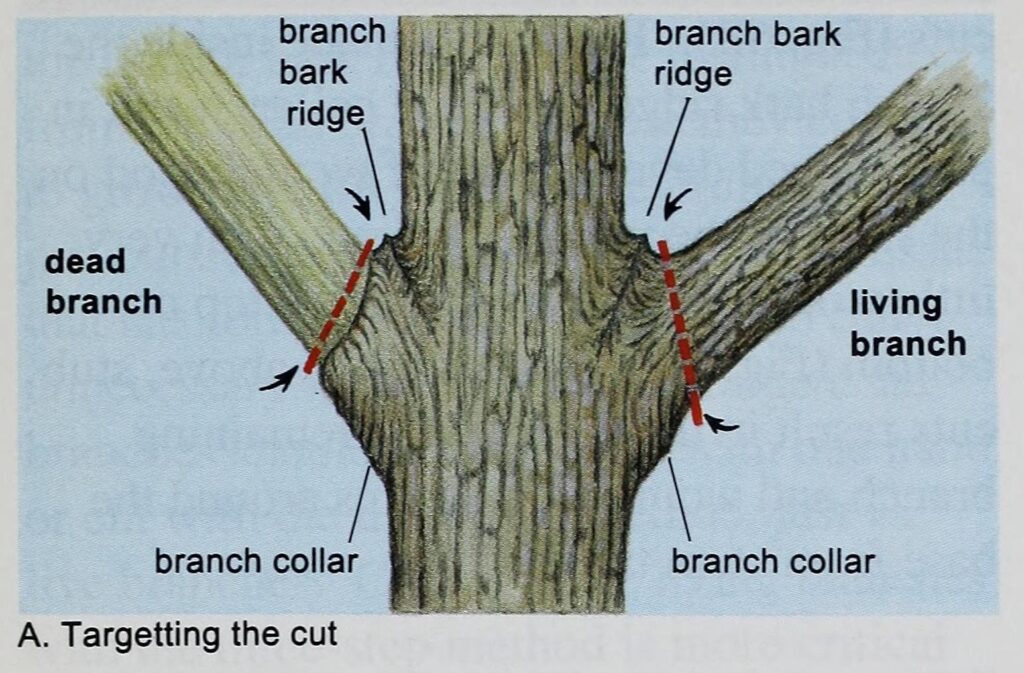
A proper finishing cut removes a branch at its natural attachment point without cutting into the trunk or leaving a long piece of branch wood.
Two features mark that attachment:
- Branch bark ridge. The raised line of bark in the crotch, where branch bark and stem bark meet and push upward.
- Branch collar. The slightly swollen ring of stem tissue at the base of the branch, often more obvious on the underside.
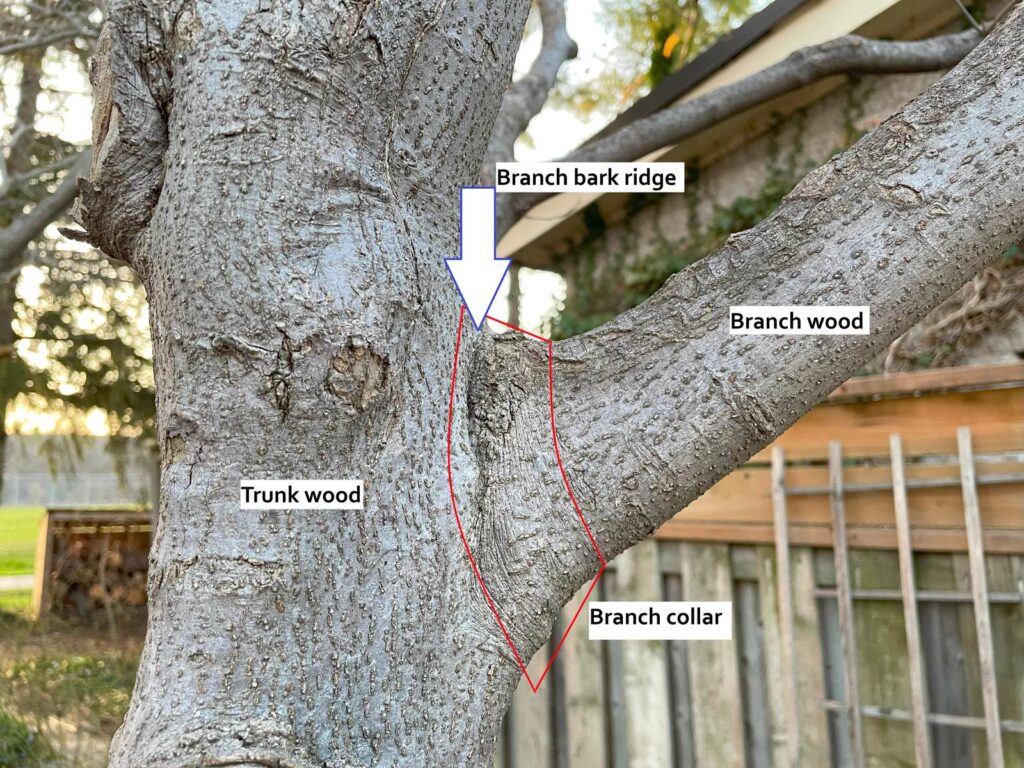

The finishing cut starts just outside the branch bark ridge and angles down and out, just beyond the branch collar. The collar stays on the tree. A small, clean shoulder of tissue remains. That shoulder is not a stub. It is the tree’s own defense tissue.
If the collar is hard to see, mirror the angle of the branch bark ridge. Do not guess a flat cut against the trunk.
On a dead branch, a living collar may already be swelling around the dead wood. Remove only the dead stub. Do not cut into that living collar.
Why the location of the cut matters
Trees do not heal the way skin heals. They compartmentalize. Arborists describe that process with the CODIT model (Compartmentalization of Decay in Trees), developed from the work of Dr. Alex Shigo.
Inside the branch collar is a branch protection zone. Chemicals in that zone help wall off decay that may already be in the branch so it does not run into the trunk. A correct finishing cut leaves that zone in place. The tree can then form woundwood, sometimes called callus, around the edge of the cut and slowly close over it.
Cut in the wrong place and you either throw that protection zone away or leave wood the tree cannot seal.
What is a stub cut?
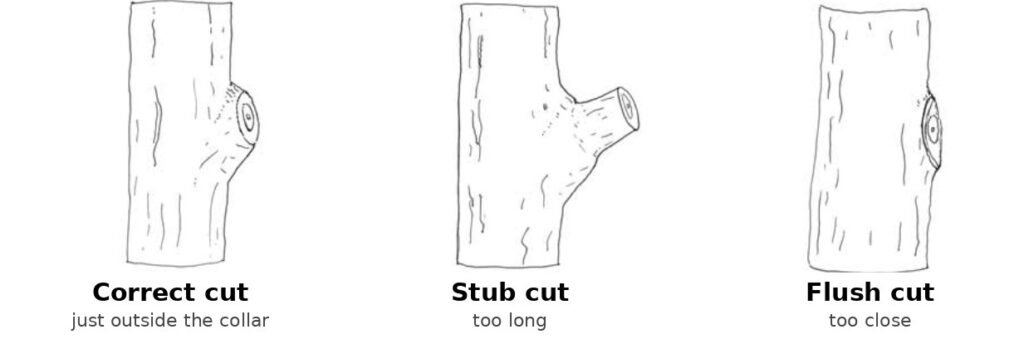

A stub cut leaves branch wood sticking out past the branch collar. The cut is too far from the trunk. Homeowners and some crews make stub cuts when they are afraid of cutting “too close,” or when they stop after a rough preliminary cut and never come back for the finishing cut.
A stub is not the same as the small shoulder left by a correct cut. A correct cut is tight to the collar. A stub is long enough that the collar cannot close over it.
Consequences of a stub cut
- The wood beyond the collar dies back. The tree cannot keep that stub alive once the branch is gone.
- Woundwood has to grow out and around the stub before it can close the wound. Closure is slow, and on a long stub it may never finish.
- Dead stub wood cracks, stays wet, and becomes an entry point for decay fungi and insects.
- Decay can work back from the stub toward the parent stem.
- Weak watersprouts often shoot from the stub or the area around it. Those sprouts are poorly attached and become future failure points.
- The tree looks unfinished, and the stub can snag, tear bark, or stay as a hazard until it rots off.
Leaving a stub does not “protect” the tree. It delays the only defense the tree has.
What is a flush cut?
A flush cut slices the branch off flat against the trunk or parent limb. It removes the branch collar and often cuts into the branch bark ridge. From the ground it can look neat. Biologically it is the worse of the two common mistakes.
Flush cuts were once taught as good practice. Modern pruning standards, including ANSI A300 and ISA best management practices, reject them. A clean-looking trunk is not a healthy cut.
Consequences of a flush cut
- The branch protection zone is cut away. Decay organisms have a clearer path into parent wood.
- The wound is larger than it needed to be, because trunk tissue was removed along with the branch.
- Woundwood forms more slowly, and the closure roll is often irregular or incomplete.
- Columns of discoloration and decay can run up and down the stem from the cut. That is internal. The bark may look fine for years.
- Cracks, cankers, and loose bark are more common around old flush cuts.
- On a structural limb or leader, a flush cut can reduce the strength of the stem that remains.
- In oaks, a larger fresh wound is also a larger target for insects that can carry oak wilt. In Central Texas that risk is not theoretical.
A flush cut trades a small, defensible wound for a large one the tree is poorly equipped to wall off.
How a proper removal cut is made
Small branches can be removed with one cut, just outside the collar, without tearing bark.
Larger limbs need the three-cut method so the branch does not strip bark down the trunk as it falls:
- Undercut. A few inches to a foot or more out from the collar, saw upward through about a third of the branch. This stops a tear from running inward.
- Relief cut. Just outside the undercut, saw from the top down and let the limb fall. Most of the weight is now gone.
- Finishing cut. Saw off the remaining stub just outside the branch bark ridge and branch collar. Support the stub so it does not tear. Do not cut into the collar. Do not leave a long stub.
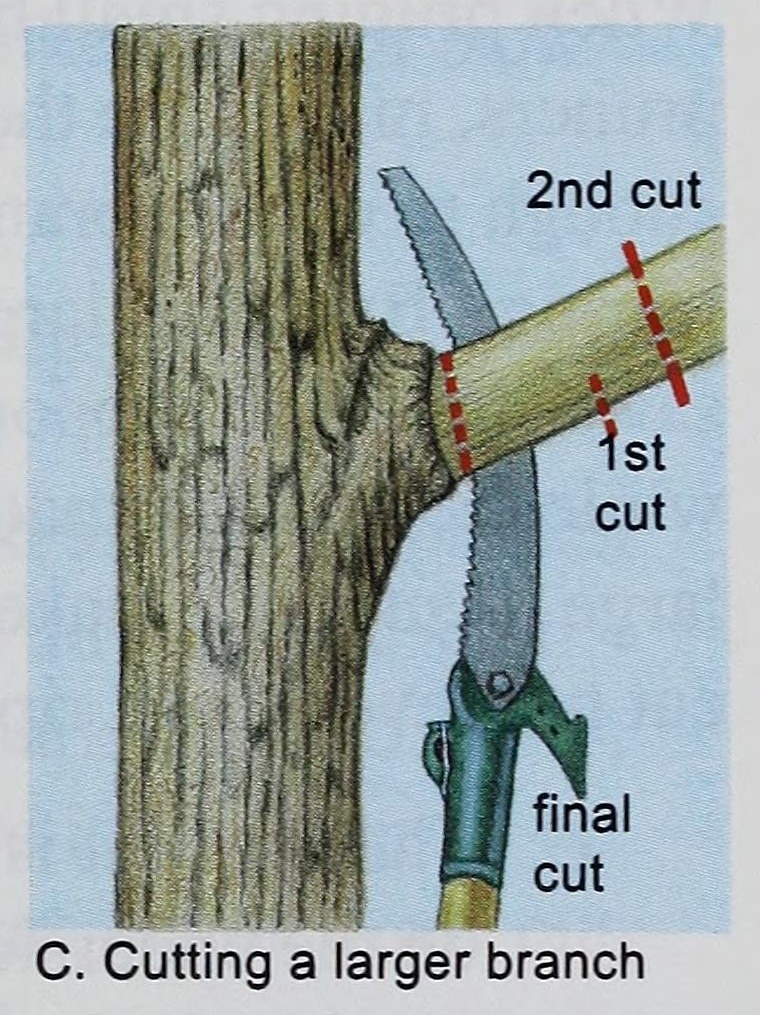
The finishing cut is the one that decides the tree’s future at that wound. The first two cuts only manage weight and prevent ripping.
Reduction cuts are different
A removal cut takes the branch off at the trunk or parent limb. A reduction cut shortens a limb back to a lateral branch that is large enough to take over the terminal role, generally at least one-third the diameter of the cut stem. The same rule applies: do not leave a stub beyond that lateral, and do not flush the cut into the remaining branch.
Topping is neither a proper removal cut nor a proper reduction cut. Topping leaves stubs or cuts to indiscriminate points and forces weak sprouting.
What good closure looks like
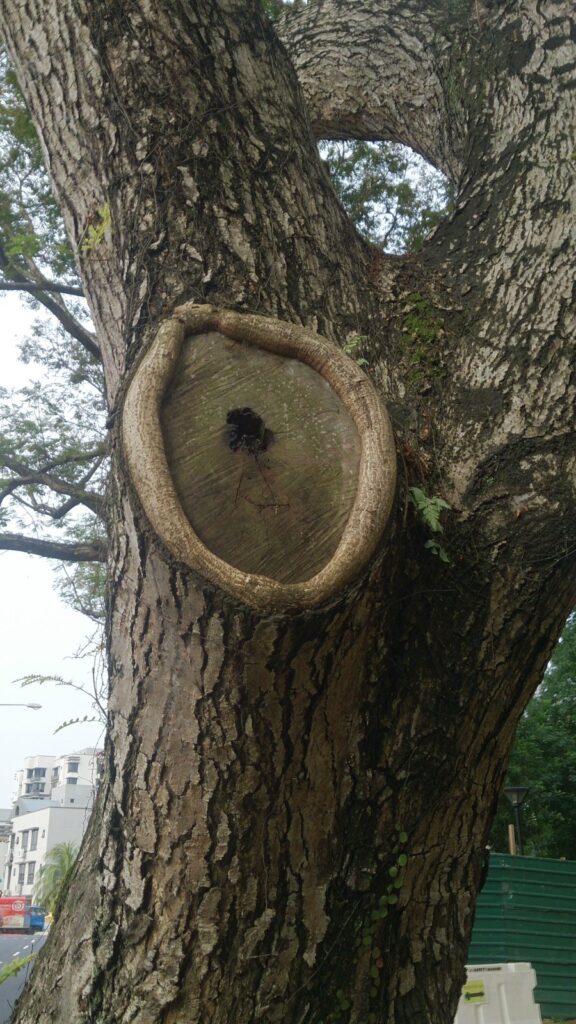

After a proper cut, woundwood should begin as a fairly even ring around the wound. Over time that ring rolls inward. A donut of woundwood with the center still open is normal on a large cut. A sunken, cracked, or one-sided roll, especially around an old flat cut tight to the trunk, often marks a flush cut. A peg of dead wood with sparse sprouts around it often marks a stub.
No pruning paint or wound dressing makes a bad cut into a good one. Research and current arboricultural guidance do not support routine wound paint for decay control. The exception that matters in our area is oak wilt. On oaks, Andrew paints fresh wounds when emergency pruning has to happen during oak wilt risk season, or when the tree is in an area with previous oak wilt outbreaks, not as a general tree-health coating. That is a disease-vector step, and it does not replace a correct cut.
Why this shows up on Waco trees
Many mature live oaks, post oaks, cedars, and pecans around Waco and Temple carry old flush cuts and stubs from past trimming. Lion’s tailing, the practice of stripping inner branches and leaving foliage only at the tips, often comes with the same poor cuts. Those wounds do not reset. They compartmentalize well or poorly based on how they were made years ago. If you are not sure where trimming ends and pruning begins, see the difference between tree trimming and tree pruning.
If a tree already has flush cuts or long stubs, the fix is not to recut them flush or to keep shortening the stub into the collar. An arborist should judge whether the wound is closing, whether decay is active, and whether the branch or stem is still structurally sound.
Frequently asked questions
What is a proper finishing cut on a tree?
A proper finishing cut removes the branch just outside the branch collar and branch bark ridge. It leaves the collar on the tree and does not leave a long stub of branch wood.
Is a stub cut the same as a proper pruning cut?
No. A stub cut stops too far from the trunk and leaves branch wood beyond the collar. That stub dies back, slows closure, and can carry decay toward the stem.
Why are flush cuts bad if they look clean?
A flush cut removes the branch collar and the branch protection zone, and it makes a larger wound in the trunk. Decay can move into parent wood more easily, and woundwood closes more slowly.
Should pruning cuts be painted?
Not for ordinary decay control. In Central Texas, paint fresh oak wounds immediately to reduce the risk of oak wilt spread by sap-feeding beetles. Paint does not fix a stub cut or a flush cut.
Can I prune large limbs with one cut?
Only small branches. Larger limbs should be removed with a three-cut method: an undercut, a relief cut to remove weight, and a finishing cut just outside the collar. One cut on a heavy limb often tears bark down the trunk.
Who should make structural pruning cuts?
Cuts that change structure, clear a roof, or remove large limbs are best done by a qualified arborist. Wise Oak Tree Service provides pruning in Waco, Temple, Marlin, and surrounding Central Texas. Call or text (254) 252-1951, or request a free estimate at wiseoaktreeservice.com/contact-us/.
The short version
A proper finishing cut is the final cut just outside the branch collar. A stub cut leaves too much branch. A flush cut takes the collar and part of the trunk with it. Stub cuts rot from the outside in. Flush cuts open the stem to decay. The right cut is the one that lets the tree do the rest.
If you want limbs removed, reduced, or cleared from a roof without stub cuts or flush cuts, Wise Oak Tree Service can assess the tree and prune to that standard.
Call (254) 252-1951 any time, or request a free estimate.
Pingback: Tree Soil Booster with Mycorrhizal Fungi | Waco, TX Arborist